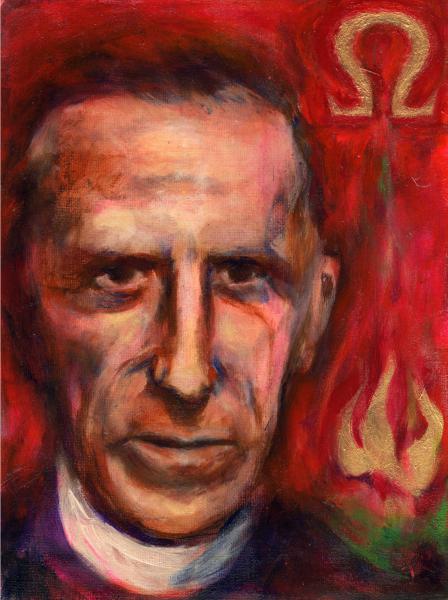
Teilhard de Chardin
Pierre Teilhard de Chardin (1881 - 1955) was a Jesuit priest and palaeontologist especially well known as a religious writer, the author of books such as “The Human Phenomenon” and “The Divine Milieu”. He was a Christian mystic, a deeply caring pastor of souls, and a thinker who meditated on the meaning of the Christian gospel in the light of modern science and evolution.
In his field work he explored the early origins of the human race especially in China.
Teilhard reflected on God and the world, and the figure of Christ in "three natures", human and divine, and what he tentatively called his "cosmic" nature. He reflected also on ecology, interfaith encounter, the greater unification of humanity, the place of the feminine and of love in creating greater unity, and the central importance of spirituality and mysticism in religious life. Central, though, is his affirmation of the incarnation as a vision of the universal cosmic Christ, of significance for the whole world and for all human beings.
Not uncritical of religion - including Christianity - as being too past-orientated, he recognised that all religions in their insights can inspire human thought and action. He saw humankind as heading for an exciting convergence of systems, an "Omega point" (this is the letter in the lower section of the painting) where the coalescence of consciousness will lead us to a new state of peace and planetary unity. Religions have an important role in the further development of the human community.
At the time, Teilhard suffered from the rejection of his writings by Catholic Church authorities but this changed. His ideas were influential for the theology behind some of the documents of the Second Council of the Vatican (1962–1965).