Speaking
about God
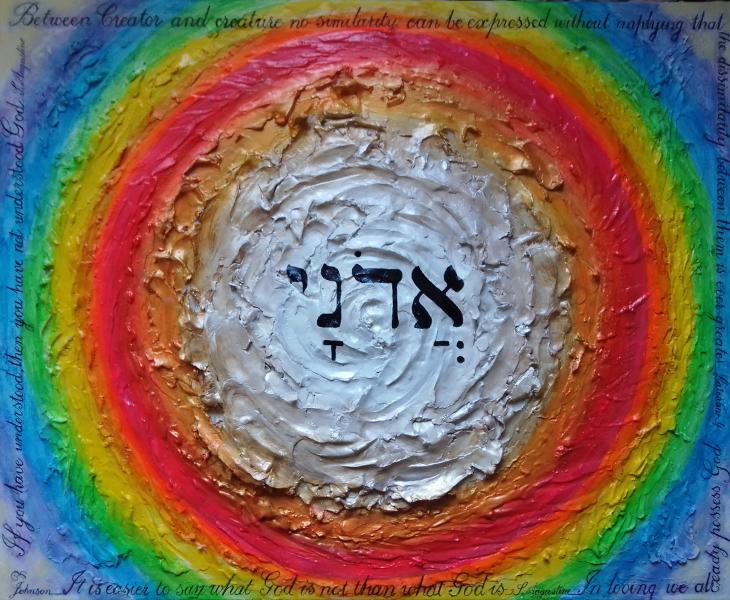
This painting attempts to express something of the mystery of God. We often imagine God using descriptive words or pictures like a father, a shepherd, almighty, powerful etc. This, however, has pitfalls because we are entering the realm of mystery where descriptors and words fail us. This image tries to capture some of the paradox of describing God in human language.
I am indebted to Elizabeth Johnson who has brought together some of the philosophy and studies on God in her “She Who Is” (which is arguing for the validity of feminist images of God) and especially some of her insights in chapter 6. My painting has a centre of white from which radiates rainbow-like colour to symbolise God the source of hope and love. The Hebrew word “Adonai” is in the middle of the painting rather than the word YHWH in Hebrew to emphasise that our language about God is always some removes away from any description of God’s essence.
In philosophy of religion one approach to describing God has been the use of analogy by which we point out how God’s attributes are partially reflected in our world and in humanity but how they are also limited. This is why I have painted some texts around the edge of my image:
Augustine “If you have understood, then what you have understood is not God” (from sermon 52, c6 n16 “Si comprehendis, non est Deus”).
Fourth Lateran Council 1215 “Between Creator and creature no similarity can be expressed without implying that the dissimilarity between them is ever greater.” (DS 806, p291).
Elizabeth Johnson “In the end, it is easier to say what God is not than what God is.” (“She Who Is” p.108)
Augustine “In loving we already possess God” (This continues “as known better than we do the fellow human being whom we love. Much better, in fact, because God is nearer, more present, more certain” De Trinitate 7.4.7)There is a kind of “agnosticism” about describing God, even for believers. For instance, In the Christian philosopher Thomas Aquinas it is said that “…theological agnosticism (is) more pervasive than has usually been acknowledged. (Aquinas says) “Now we cannot know what God is, but only what God is not; we must therefore consider the ways in which God does not exist, rather than the ways in which God does.” Elizabeth Johnson “She Who Is” p.109
We cannot compare God with anything or anyone else. God is hidden and unfathomable. This is spoken of in the prophets like Isaiah 40:18. What, then, of the coming of Jesus? This does not significantly change the incomprehensibility of God. Elizabeth Johnson states
“…the mystery of the covenanting God remains the horizon within which early Christian believers interpret the life, death and resurrection of Jesus Christ.” (“She Who Is” p106).
The painting tries to hold in balance two insights:
“What we have from early Christian theology is a pattern of positive affirmation coupled with agnosticism of definition, both essential to the truth of God. In the end, we are united to God as to an unknown, savoring God only through love.” (Elizabeth Johnson. ibid p108)